2023.11.13
The journey of recycling after the disposal of takeaway food boxes: from white contamination to recycled polypropylene particles comparable to raw materials
Page view:929
On June 20, 2023, the Ministry of Commerce and the Development and Reform Commission jointly formulated and issued the "Management Measures for the Use and reporting of disposable Plastic products by business operators in the Commercial Field" was formally implemented, and the "Management Measures" clearly stated that the establishment units of commodity retail places, e-commerce platforms (including takeout platforms) enterprises and takeout enterprises should follow the principle of authenticity and integrity
How many take-out boxes are consumed each year and how are they disposed of?
As of December 2022, China's take-out users have increased to 520 million. There are many take-out platform merchants, a variety of packaging of different ingredients, how much plastic waste is produced in the national take-out, it is difficult to count, and a large number of take-out plastic waste is mixed into domestic waste treatment. According to the 2021 "Takeaway industry packaging plastic Environmental Impact and recycling Research Report" shows that in 2020, 17.12 billion takeout orders, generating 574,000 tons of takeaway waste plastic, compared with 2015, an annualized increase of 58.7%. In 2022, take-out plastic has exceeded 1 million tons.
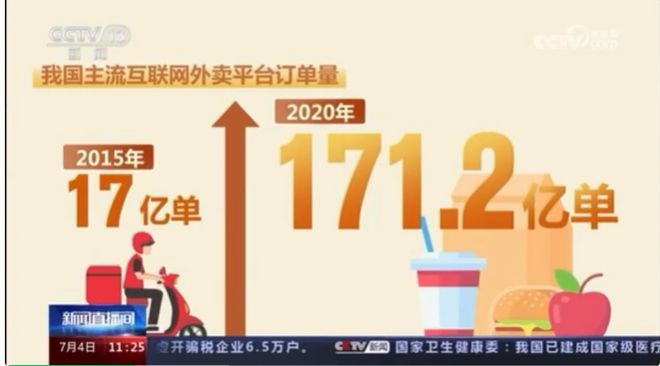
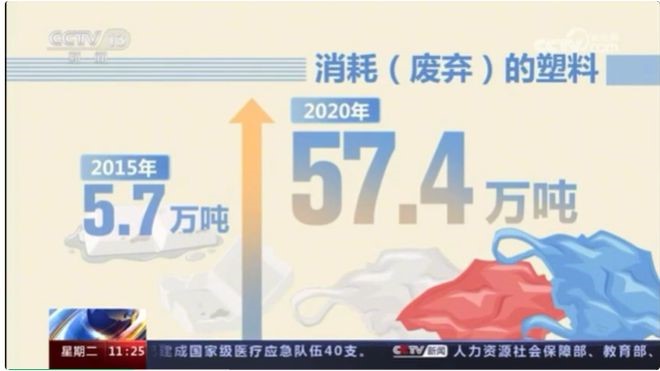
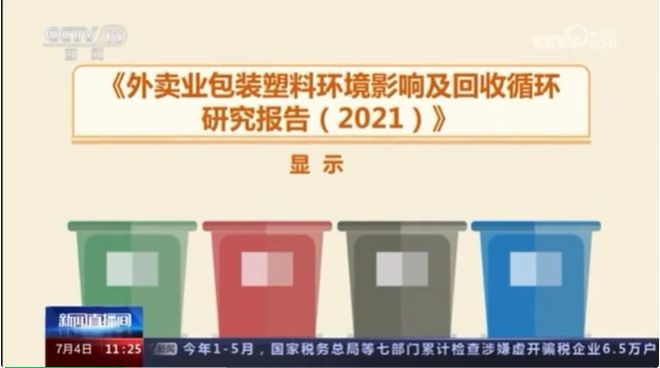
From the perspective of some mixed waste treatment methods in the country, incineration accounts for about 55% and landfill is about 40%. In the landfill process, due to its non-degradable nature, the impact of takeaway plastic waste on groundwater and soil will be relatively prominent. Data estimates that in order to harmlessly dispose of the plastic waste left by the takeout industry, it will need to pay a direct cost of at least 2.45 billion yuan in 2020 alone, which does not include the cost of carbon dioxide treatment after the incineration of plastic waste and the cost of air pollution control. To effectively control the problem of takeaway waste plastic pollution, the better way is to recycle and reuse. At present, the recycling of lunch boxes is less than 10%, and there is still a lot of recycling space, which requires higher technical requirements and more enterprises to participate in.
Three problems of plastic recycling of lunch boxes
90% of the lunch box is polypropylene (PP) material, recycling takeout lunch box, is the recycling of polypropylene. The plastic volume of takeaway food boxes is large, dispersed, not easy to collect, high degree of pollution, large meal content, and high difficulty of technical treatment; In addition, our Chinese diet is high in oil, salt and humidity, which increases the difficulty of recycling and cleaning lunch boxes. At the same time, the end products of the lunch box are light weight and small volume items, and debris is easy to mix, making his composition more complex.
In addition, for our recycled materials manufacturers, are facing a problem: although from the environmental perspective, recycled materials have a strong advantage, but from the material point of view, if not special treatment, the performance of recycled materials than new materials will be reduced, and recycled materials than new materials are often more expensive, from this point of view, the cost of recycled materials may not be high.
Difficult recycling, mixed ingredients and cost performance are the three major problems facing the recycling of takeaway lunch boxes.
Recycling process of takeaway food box
Through the process of pre-treatment, quality classification and standardized granulation modification of takeaway lunch boxes, Yujie solves three major problems, prepares high-quality polypropylene plastic particles with comparable raw material properties, provides customers with extruded, injection and blow molded raw materials, and meets the different application needs of customers in various industries. At the same time, we can provide a full range of customized innovative solutions according to customers' special requirements.
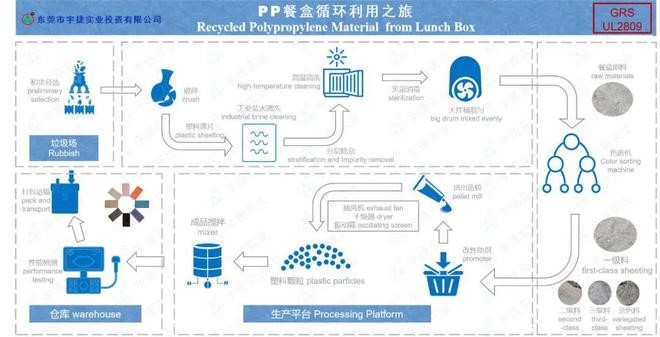
Part of it is the preprocessing of takeaway boxes. The discarded meal boxes are sorted out from the material in the dump, the lightweight plastic material is retained in the air separator, rolled into bundles, and transported to a large rotating screen for crushing treatment. These plastic sheets or small pieces of plastic are then washed with industrial salt water and high temperature, so that the plastic is decontaminated, stratified, sterilized and disinfected, and the plastic purity and raw material properties are maintained as much as possible, and finally mixed and homogenized in the large mixing bucket to obtain the PP lunch box fragments with high cleanliness.
The second part is the quality classification of lunch box raw materials. Before granulation, these food box fragments are separated by color separation equipment and their quality is graded. The color sorter equipped with the color discrimination device can accurately distinguish the color of the plastic through the light source reflected back from the plastic, and identify and sort out the full transparent dark brown. Green, blue, black and other plastic fragments. After color sorting, the plastic fragments are divided into three grades, of which the first grade is high in purity and gloss, which can ensure the same quality of products entering the subsequent process and downstream customers.
The third part is the standardization of granulation modification. This part of the step is to add additives and fillers to maximize the performance and processing properties of polypropylene. Our technical leaders improve the color, mechanics, shrinkage, flame retardancy, material content and other properties of composite materials by adding additives or fillers such as masterbatch, calcium carbonate, glass fiber, talc powder, bromodiphenyl ethane, coffee grounds, wood fiber, straw fiber, so that it can meet the individual needs of customers. These additives and plastic fragments are thoroughly mixed and melted into the extruder, and the resulting molten polymer is extruded into a material strip, which is cooled and annealed in the tank unit to solidize the polymer. The cured polymer is cut in a rotary pelletizing machine and screened through a vibrating screen for uniform shape and size, dry and easy to handle plastic particles. These plastic particles are sucked into the vertical mixing bucket by the pumping machine for the final mixing. Samples are taken from the plastic particles after mixing, chemicals, harmful substances and performance tests are carried out in the laboratory, and products that meet the quality standards and customer requirements are allowed to leave the factory and are delivered to customers.
These modified polypropylene products include toughened polypropylene, high-rigidity polypropylene, glass fiber reinforced polypropylene, fireproof polypropylene, bio-based polypropylene, the quality is comparable to the performance of new materials, has passed the GRS and UL2809 two kinds of environmental protection certification, the core products through RoHS, ReacH dangerous chemical tests, Products can be widely used in furniture accessories, textile fibers, container packaging, daily necessities, automobiles and other fields.

Previous:The breaker of the plastic cir...
Next:2023-2035 recycled plastics in...