2023.12.09
Zhong Huining: Research progress of recycled materials used in food contact materials in China
Page view:906
In order to improve the high-value application of recycled plastics, many regions actively encourage the use of recycled plastics for food contact. In addition to Europe and the United States, Japan, India, South Korea, Thailand, Indonesia, Bangladesh and other Asian countries have allowed the use of recycled plastics for food contact.
So, how is the research progress of recycled plastics used in food contact materials in China?
At the 28th China Plastic Recycling and Recycling Conference of ChinaReplas2023, Zhong Huaining, a researcher at the Key Laboratory of Food Contact Materials Testing (Guangdong), gave a wonderful speech online on the topic of "Research Progress of recycled Materials used in food contact materials in China".
Zhong pointed out that recycling is one of the important measures for the sustainable development of food contact materials, and the food-grade physical recycling of post-consumer recycled plastics (PCR) is an important means to solve plastic pollution, especially post-consumer recycled PET (rPET).
当前rPET主要降级使用于纤维领域,如果能实现瓶到瓶的食品级物理回收,有多方面的好处,如,可多次回收、具有更低的碳足迹、更小的环境影响等,当然,也会给食品安全带来更高的安全要求。
Challenge
There are several challenges to achieving food-grade applications for recycled plastics, particularly rPET:
China's supporting regulations and policies for food-grade recycled plastics are not sound;
In terms of market regulation, regulations have not yet approved recycled plastics for use in food contact materials;
In terms of policy, lack of recovery deposit system, extended producer responsibility and other policy support, food grade recovery rate is not high;
In terms of technical standards, the relevant food-grade recycled plastics technical standards are not sound, such as there is no unified standard food-grade rPET recycling quality index;
In terms of regulation, there are many departments involved in the competent authorities, and a consensus has not yet been reached on the use of recycled plastic food grade, which needs further coordination.
A very important factor is the lack of scientific research on the food-grade utilization of recycled plastics in China. Taking rPET as an example, the lack of risk assessment for rPET in China: What pollutants of high concern may exist? What are the possible risks? How can we conduct effective and challenging experiments to demonstrate that Chinese recycling plants can effectively remove contaminants from rPET? How to effectively distinguish between native PET and recycled PET to solve the problem of counterfeiting? How to correctly evaluate the environmental impact of food-grade rPET? The lack of scientific research in many aspects has led to the lack of scientific and technical support for policy making.
Current action
In recent years, China has also actively carried out relevant work. For example, the Food Safety Risk Assessment Center actively carries out risk assessment and guideline formulation work; China Development Research Foundation (CDRF) as a think tank also actively promote the implementation of food-grade rPET policy; From an industry perspective, the Joint Working Group on Sustainable Development of Food Contact Materials in China (SFCM) was established in September 2020.
Food grade rPET
Taking food-grade rPET as an example, the work is mainly carried out in the following aspects: including pollution level investigation, challenge test pollutant list, challenge test, etc.
A total of 1030 kinds of pollutants were detected by pollutant screening, and it was found that non-food sources, food residues, daily chemical additives and plastic-related substances residues were the main sources of pollutants detected by rPET, and the types and concentrations of volatile substances detected in samples from different sources had significant differences.
Further based on the research of chemical space technology, it is found that the European and American alternative lists of pollutants cannot fully cover the pollutants detected in China, and a proposed list of pollutants that can better reflect the actual situation in China is put forward.
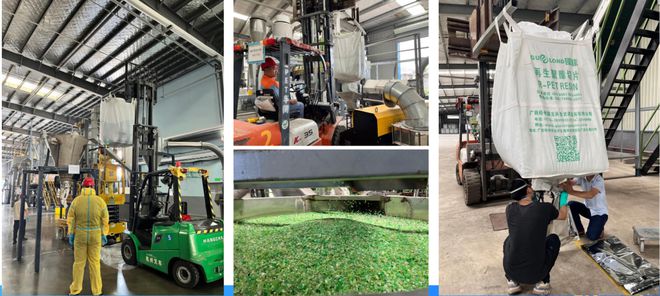
Photo of the Challenge experiment site (On site)
The challenge tests and product migration data in China's recycling plants are positive, indicating that China's rPET can be safely used in the production of food packaging if it is regulated and effective removal process.
Food grade rPE
On June 9, 2023, the China food-grade rPE work launch meeting was held in Zhenjiang, Jiangsu Province. Some preliminary research work has also been carried out with samples provided by some companies. Preliminary data detected 517 volatile and semi-volatile substances. In addition to the common alkanes, alkenes, fatty alcohols, aliphatic aldehydes, fatty acid esters, antioxidants and their degradation products in PE, the pollutants of high concern such as valallaldehyde, phthalate, chloroxylenol and benzophenone were detected frequently in rPE.
This also suggests that rPE may detect more contaminants. In comparing the detection of rPE compounds from different sources, we found that the number of detected substances and total peak area were lower in milk bottles than in daily chemical bottles, calcium milk bottles and soy sauce bottles.
(The above content is taken from Professor Zhong Huaining's speech at the 28th China Plastic Recycling and Recycling Conference ChinaReplas2023, Ningbo, November 7, 2023)
Previous:Plastic knowledge lesson - Wha...
Next:What's next for garbage sortin...